SaaS Pricing Strategies: Choose and Validate a Model
Choose a SaaS pricing model by connecting customer value, buying behavior, product economics, packaging, and evidence from real customer decisions.
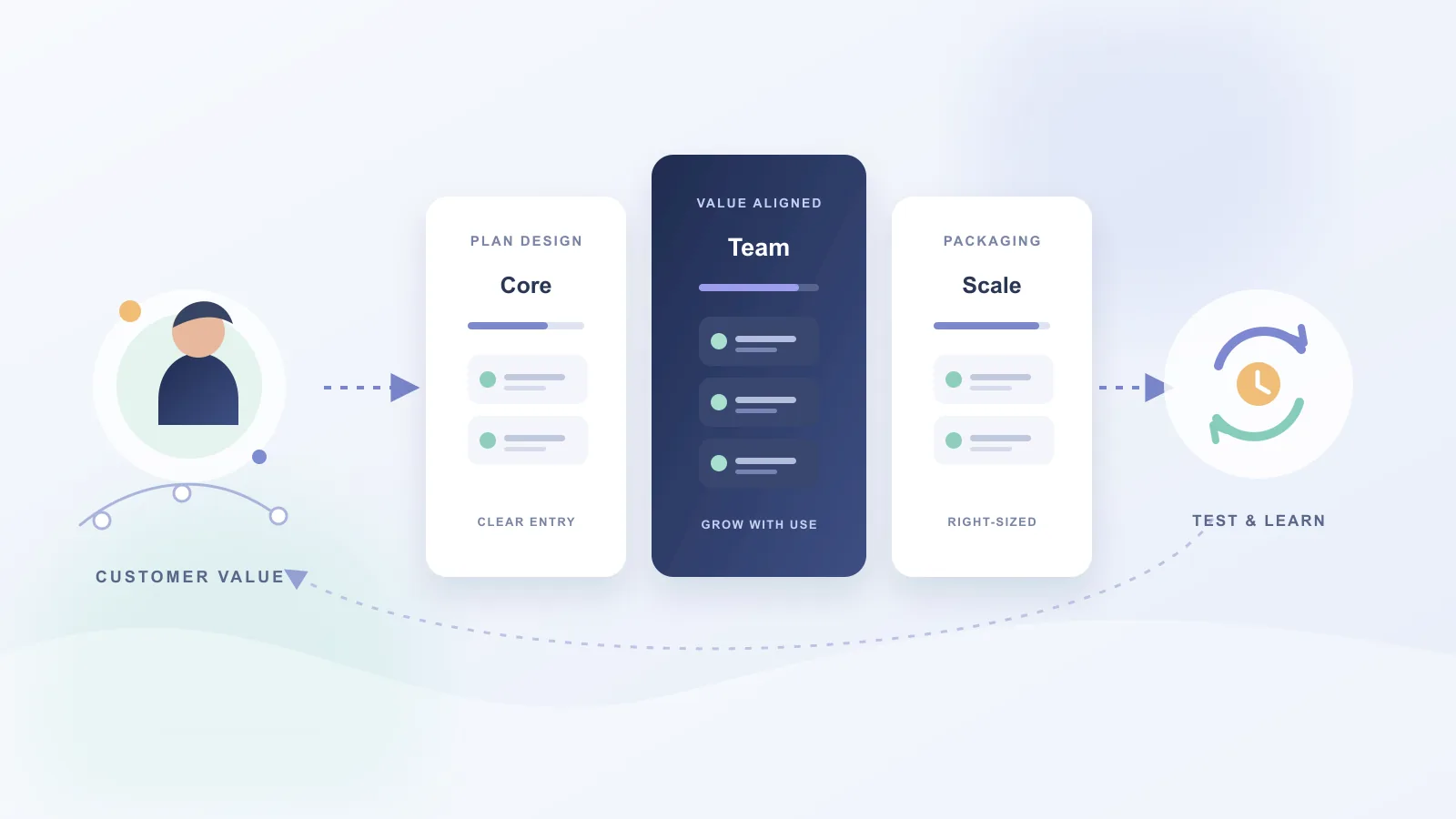
SaaS pricing is a business design decision, not a number to copy from a competitor. A workable approach connects the value a customer receives, the way that customer buys, and the costs of delivering the product. Start with a clear hypothesis about those relationships, then test the model and packaging with evidence.
The decision sequence is:
Customer segment → Value metric → Pricing model → Packaging → Price hypothesis → Experiment → Measurement → Adjustment
Separate price, model, packaging, and strategy
These terms describe different choices:
- Price is the amount charged for an offer.
- Pricing model defines how the customer is charged, such as per account, per seat, or by usage.
- Packaging groups capabilities, limits, and service levels into plans.
- Pricing strategy connects those choices to customer value, buying behavior, product economics, and business goals.
Changing a displayed price is not the same as changing the model. For example, lowering a per-seat price changes the price; moving from per-seat to usage-based billing changes the model and may also change how customers perceive and manage consumption.
Choose the model around value and buying behavior
| Model | Can fit when… | Trade-offs and failure conditions |
|---|---|---|
| Flat-rate subscription | Customers have similar needs and want a simple, predictable purchase. | A single offer can undercharge high-value use or exclude customers whose needs are smaller. |
| Tiered subscription | Customer needs fall into meaningful groups and plans can express those differences clearly. | Arbitrary feature gates and too many plans make comparison harder. A tier structure fails when customers cannot tell which plan fits. |
| Per-seat | Value and adoption tend to grow with the number of people using the product, and buyers understand seat counts. | It can discourage broad adoption or fit poorly when value comes from automation, transactions, or shared infrastructure rather than people. |
| Usage-based | A metered unit tracks value delivered and customers can understand or control usage. | Variable bills create forecasting and procurement friction. Poorly aligned meters can charge more without a corresponding increase in customer value. |
| Freemium | A useful free experience can reach users who may later expand, and serving free usage is economically and operationally viable. | Free users still create support, infrastructure, abuse-prevention, and product costs. A free tier without a credible conversion or strategic purpose can become an open-ended subsidy. |
| Free trial | Customers need to experience product value before purchase, and there is a realistic path to that value during the trial. | A trial that is too short or requires substantial setup may measure onboarding friction rather than willingness to pay. Define what event signals that the user reached value. |
| Hybrid | Different components of value or cost justify a base subscription plus seats, usage, or another variable component. | Hybrid bills can be difficult to explain and forecast. Keep the variable part tied to a customer-understood unit and show how charges accrue. |
These are options, not a ranking. The right comparison depends on the segment, the buying process, and the product’s value and cost patterns.
Define a useful value metric
A value metric is the unit that connects an offer to the customer’s use or outcome—for example, a seat, project, transaction, or amount of processed data. A good candidate usually meets three tests:
- Customers can understand what the unit means and estimate how much they will use.
- More of the unit tends to accompany more value for the customer, rather than merely more activity for the vendor.
- The company can measure, bill, and support it accurately without disproportionate complexity.
Interview customers about how they evaluate the result, who controls the budget, and what causes adoption to expand. Compare those answers with product telemetry and delivery costs, while respecting privacy and consent obligations. If the proposed metric is hard to explain or does not track customer outcomes, reconsider it before designing plans around it.
Package plans around distinct needs
Plans should help a buyer identify the option that fits a real use case. Begin with differences in scale, workflow, administration, support, or risk requirements. Make each boundary explainable: a limit or capability belongs in a plan when it reflects a meaningful difference in need, delivery cost, or service commitment.
Avoid moving core value behind a higher tier just to make the entry plan feel incomplete. That may create a short-term upgrade prompt while making the product harder to evaluate or trust. Instead, state who each plan serves, what is included, what is metered, and what happens at a limit. Check the complete path from first use to a larger account so that an upgrade does not require avoidable reconfiguration or data migration.
Evaluate free offers and commitment options
Freemium and a free trial answer different questions. Freemium provides an ongoing limited version; a trial provides temporary access to a paid experience. Choose between them by considering time-to-value, the cost of serving non-paying users, how buyers evaluate the product, and whether the team can support the transition to payment.
For either approach, define the hypothesis before launch. For example: “If a trial user imports a project and invites a teammate, that user is more likely to understand the collaborative value.” Measure the defined activation event and subsequent purchase behavior. Do not infer willingness to pay from sign-ups alone.
Monthly and annual options also involve a trade-off. A monthly plan can reduce the customer’s commitment and give the business earlier evidence about continued value. An annual plan can make spend more predictable and collect cash earlier, while shifting more commitment and refund risk to the customer and business. A discount reduces the effective price; it is justified only if the resulting change in conversion, commitment, collection timing, or retention is worth the revenue given up. Model those effects for the relevant segment and test where feasible. No discount percentage guarantees better retention or cash flow in every business.
Make usage and hybrid charges understandable
Usage pricing can connect a bill to consumption, but only if the customer sees the connection and can plan around it. Publish the unit, measurement window, included amount if any, and overage treatment. Provide usage visibility and alerts where practical. Before launch, test edge cases such as retries, shared accounts, delayed events, credits, and disputes; inaccurate metering undermines trust.
For hybrid plans, make the fixed and variable parts explicit. A base fee may cover platform access or a stable service level, while usage charges track a variable resource or outcome. Explain which part changes as the customer grows and model how gross margin behaves across low, expected, and high use. If a customer cannot estimate a representative bill, improve the model or the explanation before scaling it.
Validate a pricing hypothesis
Pricing research should combine evidence rather than treat one interview or one experiment as an answer:
- Choose a segment. State which customer type and buying context the decision concerns.
- Describe the value. Identify the outcome customers seek and the evidence that the product contributes to it.
- Write the hypothesis. Specify the model or packaging change, the expected customer behavior, and why that behavior should change.
- Check constraints. Review cost to serve, margin, procurement, billing, legal, and implementation requirements.
- Gather evidence. Use customer interviews, observed buying objections, win/loss notes, usage patterns, and controlled experiments when traffic and ethics permit.
- Measure and decide. Compare the result with a defined baseline and guardrails. Keep, revise, or roll back the change based on the evidence.
Do not run an A/B test simply because pricing can be displayed in two variants. The sample, customer mix, sales cycle, and downstream retention may make a quick conversion comparison misleading. Keep offers transparent, avoid discriminatory or deceptive presentation, and do not make existing customer terms ambiguous. When experimentation is not suitable, use structured interviews and cohort analysis while documenting the limits of those methods.
Select metrics for the decision
Metrics answer different questions and should not be treated as interchangeable:
| Decision | Useful measures | Interpretation to keep in mind |
|---|---|---|
| Is the trial experience reaching value? | Defined activation event, trial-to-paid conversion | Conversion alone does not explain onboarding friction or later retention. Define the eligible trial cohort and observation window. |
| Is the free offer contributing to paid adoption? | Free-to-paid conversion, time to conversion, paid expansion by cohort | A low conversion rate may still support a deliberate acquisition strategy, but that purpose and its service cost should be explicit. |
| Is the model sustainable? | Gross margin by segment or usage band, cost to serve | Averages can conceal high-cost cohorts or usage patterns. State what costs are included. |
| Are customers staying and expanding? | Customer retention, revenue retention, expansion and contraction revenue, churn by segment or plan | Revenue retention can rise while customer count falls; use both where the distinction matters. Define the period and treatment of upgrades and downgrades. |
| Is acquisition economics changing? | Customer acquisition cost and payback period by segment | Allocation methods and sales cycles affect these measures. Compare consistent cohorts rather than treating a single month as conclusive. |
| Is usage pricing predictable? | Usage distribution, bill variance, overage incidence, support contacts about billing | High usage is not automatically healthy if it produces unexpected bills or weak margins. |
Average revenue per account or user can help track mix and trend, but define the numerator, denominator, period, and treatment of discounts. It can rise because of expansion, customer loss among smaller accounts, or a change in customer mix; inspect the underlying cohorts before attributing cause.
Common pricing mistakes
- Copying a competitor’s price: Their segment, costs, service, and sales motion may differ. Use alternatives as context, then test your own value proposition.
- Pricing only from costs: Costs constrain viable offers but do not establish what a customer values or will buy.
- Changing several variables at once: If price, model, and packaging all change together, it becomes harder to learn what affected behavior.
- Adding complexity without a customer distinction: More tiers and add-ons increase comparison and billing work.
- Discounting without a hypothesis: A reduced price may accelerate a decision, reduce revenue, or attract a different mix; measure the relevant outcome rather than assuming it improves retention.
- Optimizing sign-ups alone: Initial conversion says little about delivered value, support burden, margin, or continued use.
- Ignoring billing operations: Metering, invoices, taxes, refunds, failed payments, and customer questions are part of the pricing experience.
A practical decision framework
Before changing an offer, write a one-page decision note:
| Step | Record |
|---|---|
| Customer | Segment, buyer, user, and purchasing context |
| Value | Outcome the customer seeks and evidence that the product delivers it |
| Metric | The unit that reflects value and can be measured reliably |
| Model and package | How the customer pays and what each offer includes |
| Economics | Cost to serve, gross margin, billing and support burden, and downside cases |
| Hypothesis | The change, expected behavior, and reason for the expectation |
| Evaluation | Primary measure, guardrails, cohort, observation window, and decision threshold |
| Review | What evidence would lead the team to keep, revise, or reverse the offer |
This note makes assumptions visible and prevents a pricing change from becoming an unexplained interface tweak. Revisit it when customer needs, product value, cost structure, or the sales process changes.
If your next decision is how to assemble the operating software around a startup, see the separate guide to choosing tools for a startup workflow. It covers tool selection; this article focuses on charging customers for your own SaaS product.
Frequently Asked Questions
What is the best SaaS pricing model?
There is no model that fits every SaaS business. Match the charge to the value customers receive, how they buy, and how your costs scale; then validate whether customers understand and accept it.
How do I choose a value metric?
Look for a measurable unit that customers associate with value, that tends to grow as they receive more value, and that your product can meter and explain reliably. Test whether buyers can predict the bill before committing.
Should I offer annual plans or discounts?
Offer an annual option when customers can reasonably commit and the cash-flow or retention economics justify the obligation. Model the revenue forgone, refund exposure, and customer risk; test the offer rather than assuming a discount improves retention.
When should a SaaS company use usage-based pricing?
Consider it when a usage unit closely tracks delivered value and customers can forecast or control consumption. It can be a poor fit when bills are difficult to predict, usage is disconnected from value, or metering and billing add operational burden.
Related Articles
Best SaaS Tools for Startups: Build a Lean Stack
Choose startup SaaS tools by workflow, stage, total cost, integrations, and exit risk. A practical shortlist explains when to adopt each tool—and when to wait.
Linear Review 2026: Is It Worth It for Your Engineering Team?
Linear review: compare features, GitHub workflows, pricing, and Jira trade-offs. Find out which teams benefit most—and when Linear is not worth switching to.
Clerk vs Auth0 vs Supabase Auth: Which Fits Your B2B SaaS?
Compare Clerk, Auth0, and Supabase Auth for B2B SaaS by organization management, enterprise SSO, authorization, integration effort, pricing, and migration risk.

Cursor Review: Is the AI Editor a Fit for Your Workflow?
A practical Cursor review for developers: current editor and agent workflows, privacy and permissions, pricing, trade-offs, and a repeatable way to evaluate it in your own repository.