How Much Architecture Does Your SaaS Actually Need?
A practical guide to deciding how much SaaS architecture a founder actually needs, when a monolith is enough, and when complexity is justified by real product and operational requirements.
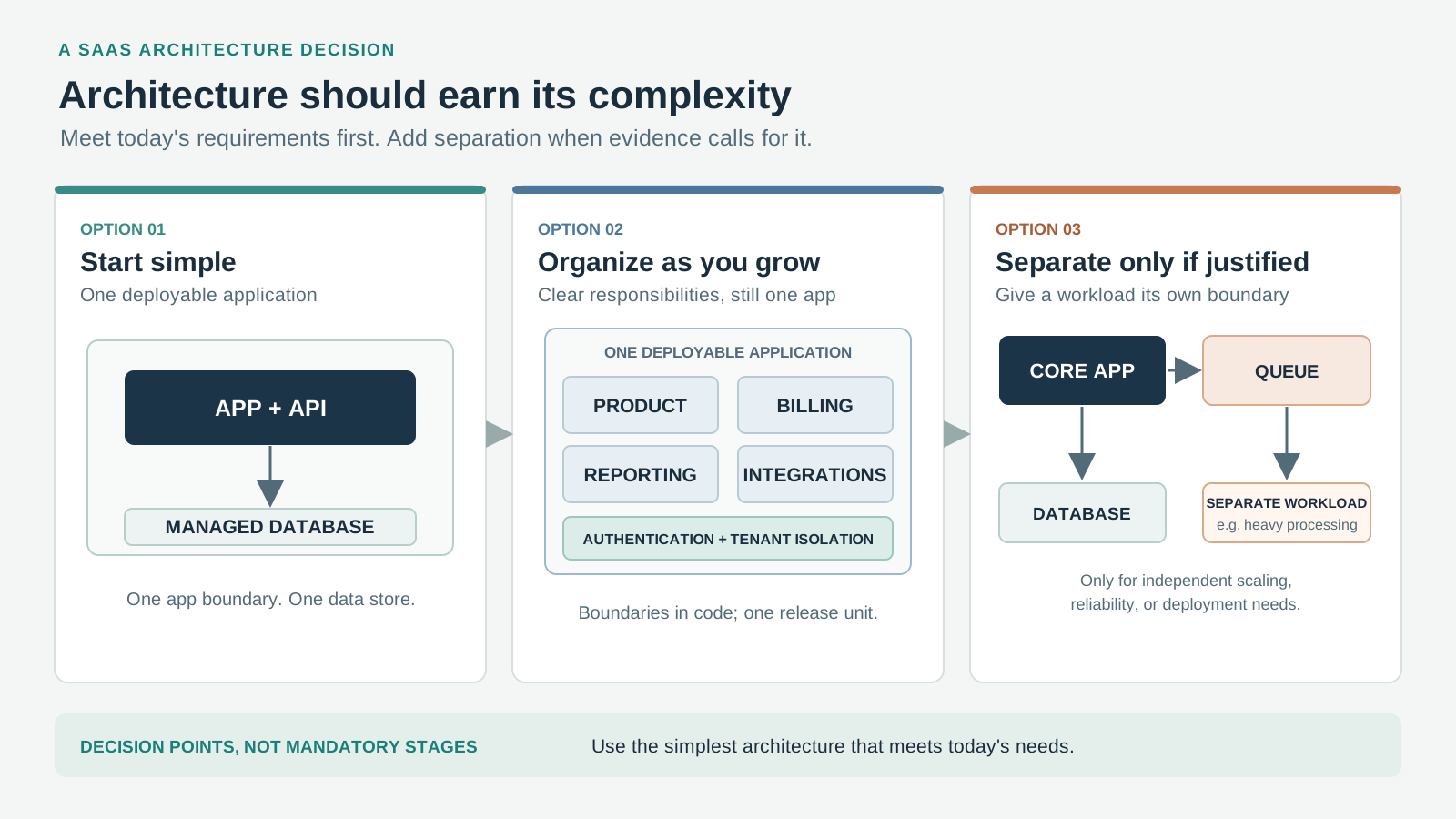
You are not deciding whether a SaaS is technically possible.
You are deciding how much structure the product actually needs before it becomes expensive, fragile, or slow to change.
That is the real question behind architecture.
A founder may say, “We need a robust architecture,” and mean, “We do not want to rebuild this later.” That is a reasonable concern. But it is easy to confuse a product’s future ambitions with the system it needs today.
The more useful question is:
How much architecture does this SaaS need to be safe, maintainable, and successful at its current stage?
This is not a theoretical debate about software purity. It is a practical decision about the cost of complexity.
The principle: build for known requirements, not imagined scale
A lot of SaaS architecture advice fails for the same reason: it treats future scale as if it were a current requirement.
That creates expensive choices too early.
A founder does not need a distributed system because a product might someday serve a million users. The product needs a system that is reliable enough for the users it has now, the data it handles, the risks it creates, and the team that will operate it.
The right order is:
product requirement → user workflow → capability → operational risk → architecture decision
That makes architecture a decision about evidence, not status.
A startup does not get to skip the hard work of engineering judgment simply because it is small. But a startup also does not need the same architecture as a mature platform with multiple product teams, regulated data, or complex authorization rules.
The best architecture is usually the one that is:
- clear enough for the team to reason about,
- simple enough to operate without constant firefighting,
- flexible enough to change as the product evolves,
- and specific enough to match the product’s actual constraints.
That is not “cheap” engineering. It is disciplined engineering.
The minimum viable SaaS architecture
For most early SaaS products, the minimum viable architecture is not a fantasy full-platform system. It is a small set of clearly separated responsibilities.
A typical first version can work with:
- a frontend for the customer experience,
- a backend or application layer for business logic,
- a database for records and transactions,
- authentication and authorization,
- file or object storage when documents or media are part of the product,
- a managed email or notification service,
- basic monitoring, logs, backups, and deployment automation,
- and externally managed services for payments, AI, or other workflows when those are not core product differentiators.
That is enough for a successful MVP if the product is designed around a narrow set of real workflows.
The key distinction is between a working MVP and a production-ready service.
A working MVP
A working MVP proves the core user value. It may be intentionally narrow and can accept some trade-offs. It exists to validate the product and business model.
It should still be secure enough to protect user data, resilient enough to handle normal error conditions, and maintainable enough that a founder or small team can understand and change it.
A production-ready service
A production-ready service is a different standard. It includes stricter systems for:
- backups, recovery, and data retention,
- access control and least-privilege authorization,
- observability and incident response,
- deployment automation and rollback,
- rate limits and abuse prevention,
- dependency management and vendor review,
- customer support and operational ownership.
The difference is not just “more features.” It is a higher bar for reliability, accountability, and operational safety.
A user can have a rough but functional MVP before the product is stable. That is acceptable. What is not acceptable is confusing a rough MVP with a platform that can safely handle a large customer base or sensitive data.
Monolith, modular monolith, and microservices are not the same thing
This is where many founders get lost.
A monolith
A monolith is a single deployable application. It keeps the main product logic in one codebase or a small number of tightly connected modules.
For many early products, this is the right starting point. It reduces coordination cost, keeps delivery speed high, and is easier to debug and ship when the team is small.
A monolith is not automatically “bad.” It is simply a single deployment unit.
A modular monolith
A modular monolith keeps one deployable application but organizes the code into clearer internal boundaries such as billing, user management, project logic, notifications, or reporting.
This is often the best compromise for growing SaaS products. The team still ships one application, but the codebase has stronger structure. It is easier to evolve without creating a distributed system too early.
This is a strong option when the product has meaningful complexity but has not yet reached the point where independent deployment or separate operational models are needed.
Microservices
Microservices split capabilities into separately deployable services that communicate over APIs.
That can be useful when the system has real separation of concerns, like a user service, billing service, AI pipeline, or data processing worker that are each independently scaled, deployed, and monitored.
But microservices also introduce cost:
- more deployment coordination,
- more operational complexity,
- more network failure modes,
- more cross-service debugging,
- and more incident management burden.
The key idea is that architecture choice should track the product’s actual needs. A modular monolith can be a better decision than microservices even when the product is technically sophisticated.
The real distinction: separation of responsibility vs separate deployment units
This matters more than the vocabulary.
A team can logically separate responsibilities without turning the system into a network of services.
For example, your application may have distinct modules for:
- authentication,
- billing,
- user onboarding,
- reporting,
- search,
- notifications,
- and AI workflows.
That is a good design boundary.
It does not automatically require separate deployment units.
The product can still be a single application with clean boundaries and clear ownership.
That is often better than prematurely splitting into separate services just because the model looks “modern.”
The warning sign is confusing a design principle with a deployment strategy.
A team can have clear modules, good interfaces, well-defined responsibilities, and a single deployable application. That is not necessarily a monolith in the negative sense. It is often a more practical foundation.
A practical decision matrix
Here is a simple decision model a founder can apply.
| Situation | Typical recommendation | Why |
|---|---|---|
| Small product, few users, limited risk | Monolith or modular monolith | Fastest path to learning and easy to operate |
| Product needs strong internal structure but still one deployable app | Modular monolith | Keeps complexity manageable without distributed-system overhead |
| Different capabilities have distinct failure modes or scaling needs | Split into services only when justified | Real operational separation is easier to defend than theoretical future scale |
| AI, billing, file processing, and web app all need independent operational control | Service boundaries may be worth it | Different workloads and failure risks often require different scaling and monitoring |
| Sensitive customer data, compliance, or strict access control | Strong architecture and clear authorization boundaries | Simplified design is not enough if risk is material |
| Team is small and product is still uncertain | Keep the architecture lean | The best architecture is the one the team can safely change |
A founder should not ask,
“What is the most scalable architecture?”
The better question is:
“What architecture will allow us to ship, learn, protect customers, and change direction without unnecessary overhead?”
Requirements that change the architecture
Not every SaaS needs the same architecture. The product’s context changes the recommendation.
Multi-tenancy
If each customer or workspace must be isolated from the others, the product needs a clear tenant model, access rules, and often separate data boundaries. This can be handled in a single application, but the architecture needs to respect isolation from the beginning.
A product that stores one user’s data beside another user’s data has different architectural demands than a consumer app with a single user model.
Payments and billing
If the product charges users, subscription logic, invoicing, retries, entitlement checks, and customer lifecycle events become operationally important. Many founders should buy a managed payment platform instead of building billing logic in-house.
A founder can still keep the application simple, but the product now has a direct financial and compliance responsibility.
Sensitive data
If the SaaS handles health data, internal business data, employee records, or customer information with legal or reputational consequences, the architecture must pay extra attention to access control, retention, encryption, auditability, and secure deployment.
This does not necessarily require a large distributed design. It does require disciplined architecture and operational controls.
Integrations
If the SaaS needs to connect with CRMs, accounting systems, ERP tools, cloud providers, or customer-specific APIs, the architecture needs clear integration boundaries and error-handling rules. This often pushes teams toward a modular monolith or separate worker processes, not necessarily a full microservice platform.
AI features
AI can change the architecture in obvious and subtle ways.
An AI feature may add:
- model provider integration,
- prompt orchestration,
- long-running jobs,
- file processing,
- vector search or retrieval,
- and cost-sensitive API usage.
This does not mean every AI product becomes microservices by default. It means the architecture needs to account for latency, failure handling, observability, and cost management.
What to build, buy, and defer
A founder’s architecture should also decide what is core and what is commodity.
Usually worth buying
Most SaaS products should buy managed versions of:
- authentication and session management,
- payment processing,
- file storage and document hosting,
- email and notifications,
- hosting and deployment,
- observability and basic analytics,
- and some AI inference or model services if the product is not built around custom model infrastructure.
This reduces operational drag and lets the team focus on the actual customer problem.
Usually worth building in-house
The product-specific parts are usually worth building in-house:
- user workflows,
- the business logic that defines product behavior,
- access rules specific to the product,
- data model design,
- and the product’s unique interpretation of user goals and decisions.
This is where the SaaS creates value. It should not be outsourced to a generic platform unless the product genuinely depends on that platform’s structure.
Usually worth deferring
A founder should defer:
- advanced internal platform engineering,
- multi-region global architecture,
- custom infrastructure automation,
- elaborate event-driven systems,
- and deep observability pipelines,
unless the product has concrete needs that require them.
A lot of “needed architecture” is actually “possible architecture” that looks good on a slide but is expensive to maintain.
Decisions that deserve early attention
Some architectural decisions are inexpensive to change now and expensive later.
These deserve early attention:
- data model and relationships,
- authentication and authorization model,
- how tenants or workspaces are isolated,
- payment and subscription flow,
- API boundaries between product layers,
- environment and deployment process,
- backups and recovery expectations,
- and dependency/vendor strategy.
These are not “future concerns.” They are core product architecture decisions because they shape how much complexity the system must carry.
If a product starts with weak permissions, unclear data ownership, or an API design that couples everything together, the team will pay for that design later.
The important point is not to obsess over every future scenario. It is to make early decisions that are hard to reverse without real cost.
Warning signs of overengineering and underengineering
Warning signs of overengineering
- the team is building services before they have a clear failure mode or customer need,
- product requirements are unclear but the architecture is already highly distributed,
- every feature gets its own service because “it might scale someday,”
- there is more infrastructure complexity than product complexity,
- nobody can explain why each service exists in plain language,
- and updates are slow because every change requires cross-team coordination.
Warning signs of underengineering
- users can access data they should not see,
- backups and recovery are ad hoc,
- a single database or API dependency becomes a fragile point,
- support work is blocked by fragile deployments,
- failures are not observed or understood quickly,
- and the team cannot safely change one product area without breaking another.
Simplicity is not the same as irresponsibility. Good architecture reduces unnecessary complexity while still controlling real risks.
A practical pre-build architecture checklist
Before the first meaningful build, a founder should be able to answer yes or no to the following:
- What does the product actually do, in one or two workflows?
- What are the required user and permission models?
- What data must be stored, and what is the minimum data model?
- Which dependencies are core to the product, and which are commodity services?
- Which parts are likely to change often?
- Which parts need stronger reliability or security controls?
- What are the critical failure modes?
- What is the simplest deployment and monitoring setup that still gives visibility?
- What would make the system expensive to change later?
- What can we defer until the product clearly proves the need?
If those answers are vague, the product likely needs more product definition before architecture becomes meaningful.
A worked example: the same idea, different architecture needs
Imagine a founder wants to build a product for managing customer interviews and extracting actionable insights.
Phase 1: early prototype
The product might have:
- login and workspace access,
- a simple database,
- document upload,
- text extraction,
- AI-generated summaries,
- and a basic dashboard.
At this stage, a monolith or modular monolith is usually the right choice. The team may use a managed database, auth provider, file storage, and AI API. That is enough to validate the product.
Phase 2: growing SaaS
If the product starts serving several customers and the team adds:
- multi-tenancy,
- usage limits,
- workflow automation,
- integrations with CRMs,
- background jobs,
- and tenant-specific settings,
then the architecture may need more separation: clearer modules, background workers, stronger access rules, and more careful monitoring.
This still may not require microservices. A modular monolith is often the best answer.
Phase 3: platform product
If the product eventually adds a public API, many independent integration partners, heavy asynchronous processing, strict compliance needs, and team ownership boundaries across multiple product areas, then separate services or specialized infrastructure become more defensible.
That is when architecture complexity starts to pay off because the operational and product constraints justify it.
The main point is that the architecture evolves with the product. It does not need to be fully future-proof on day one.
Conclusion: choose the architecture that matches the work, not the fantasy
A SaaS does not need a grand architecture to get started. It needs a system that is explicit about responsibilities, safe for its users, and easy enough for the team to maintain while the product is still being learned.
The simplest architecture that satisfies real requirements is usually the right architecture for the current phase.
That means:
- use a monolith when the product is still being proven,
- move to a modular monolith when internal complexity becomes hard to manage,
- and adopt separate services only when the product and operating realities demand them.
The question is not whether the system looks impressive.
The question is whether the architecture matches the real product and the real risks.
If you are still deciding the shape of your SaaS, the next action is straightforward:
define the product’s required workflows, data, user model, integrations, and operational risks, then choose the smallest architecture that safely supports them.
That is where architecture becomes useful rather than theatrical.
Further reading
- What Technology Does Your SaaS Actually Need?
- How to Choose a Tech Stack for Your SaaS
- How to Design a SaaS Architecture
- Can You Build a SaaS Without Being a Developer?
For a founder, the common mistake is not to build too little. It is to add complexity before the product has earned it.
Frequently Asked Questions
What is the minimum viable architecture for a SaaS?
The minimum viable architecture is usually a single deployable application with a clear frontend, backend, database, authentication layer, and basic monitoring. It may rely on managed services for storage, email, payments, and hosting without introducing extra deployment units unless the product genuinely needs them.
When does a SaaS need microservices?
A SaaS usually needs separate services when different product capabilities have different failure modes, security requirements, deployment cycles, or scaling needs, and the team can support the operational overhead. Most early SaaS products do not need that complexity until the business and operating model justify it.
Is a monolith always a bad idea?
No. A monolith is often the correct early-stage choice because it reduces decision overhead, makes product iteration easier, and keeps operational complexity low while the product is still being validated. It becomes a problem only when it creates unnecessary coupling or fails to support real business or security requirements.
What should a founder buy instead of build?
Most founders should buy managed authentication, payments, file storage, email, analytics, monitoring, and hosting unless they have a strong reason to build custom infrastructure. The goal is not to avoid all technical decision-making; it is to avoid building infrastructure that is already proven and well supported by vendors.
Related Articles
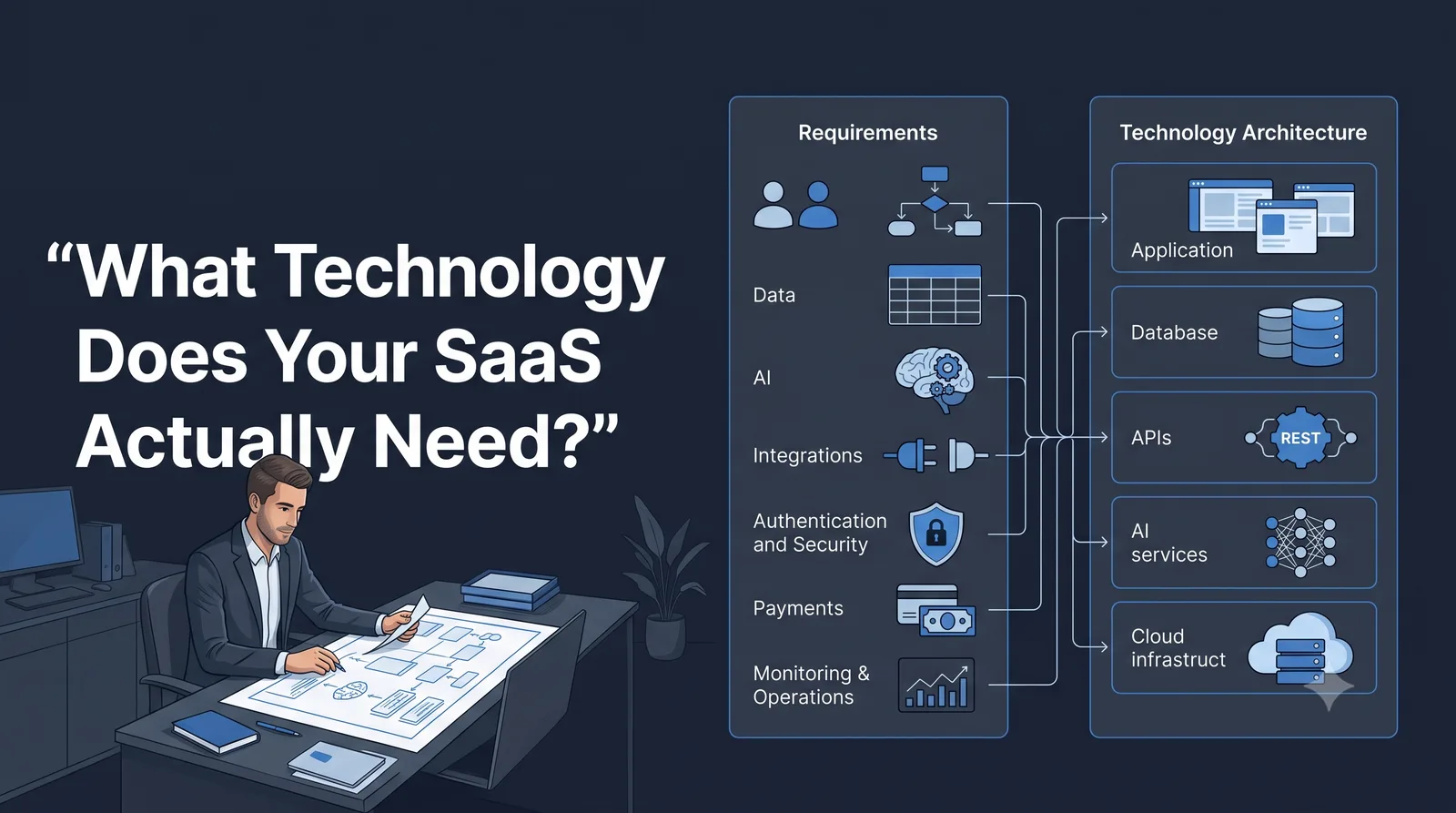
What Technology Does Your SaaS Actually Need? A Nontechnical Founder’s Guide
SaaS requirements explained for nontechnical founders. Learn what technology your SaaS actually needs, from data and AI to integrations, security, and MVP requirements.
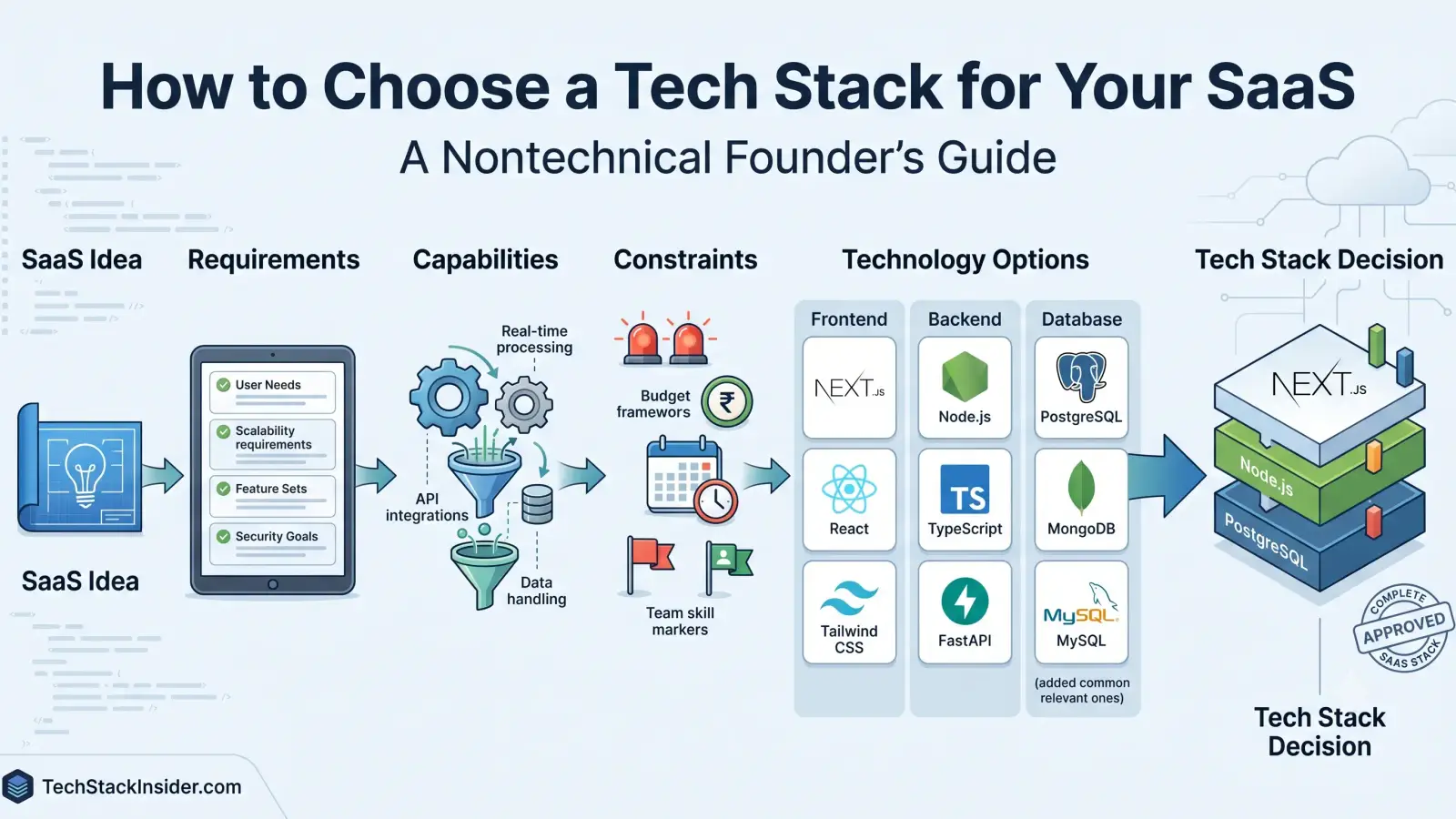
How to Choose a Tech Stack for Your SaaS
A practical guide for nontechnical SaaS founders to choose a tech stack by defining product requirements, comparing capabilities, and weighing cost, complexity, security, and team constraints.
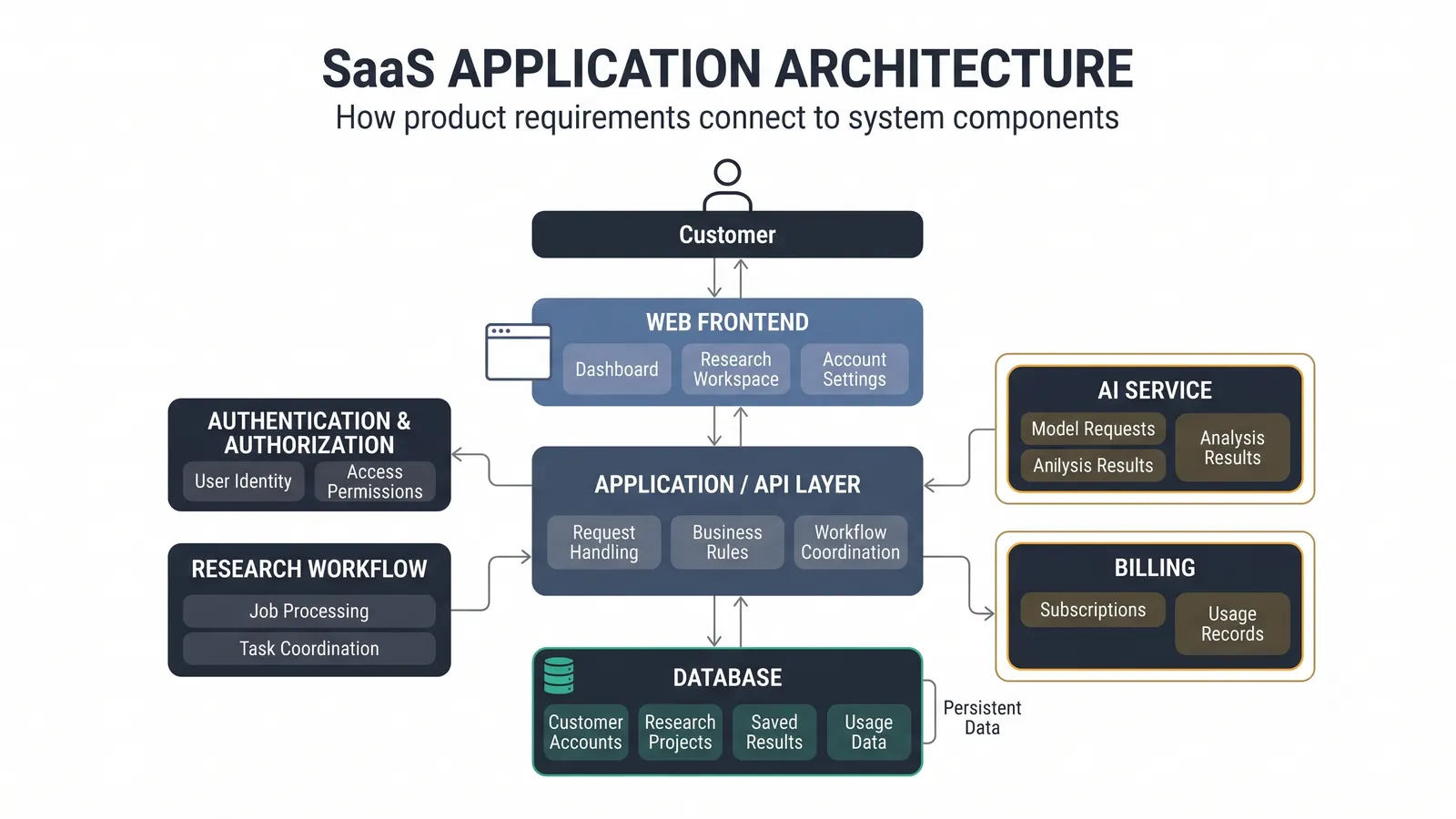
How to Design a SaaS Architecture: A Nontechnical Founder’s Guide
A practical guide to designing a SaaS architecture by connecting product requirements, system capabilities, technology components, relationships, and architecture decisions.

Can You Build a SaaS Without Being a Developer? What You Really Need to Know in 2026
A practical guide for nontechnical founders evaluating AI, no-code, low-code, and developer-assisted approaches to building and operating a SaaS.