How to Choose a Tech Stack for Your SaaS
A practical guide for nontechnical SaaS founders to choose a tech stack by defining product requirements, comparing capabilities, and weighing cost, complexity, security, and team constraints.
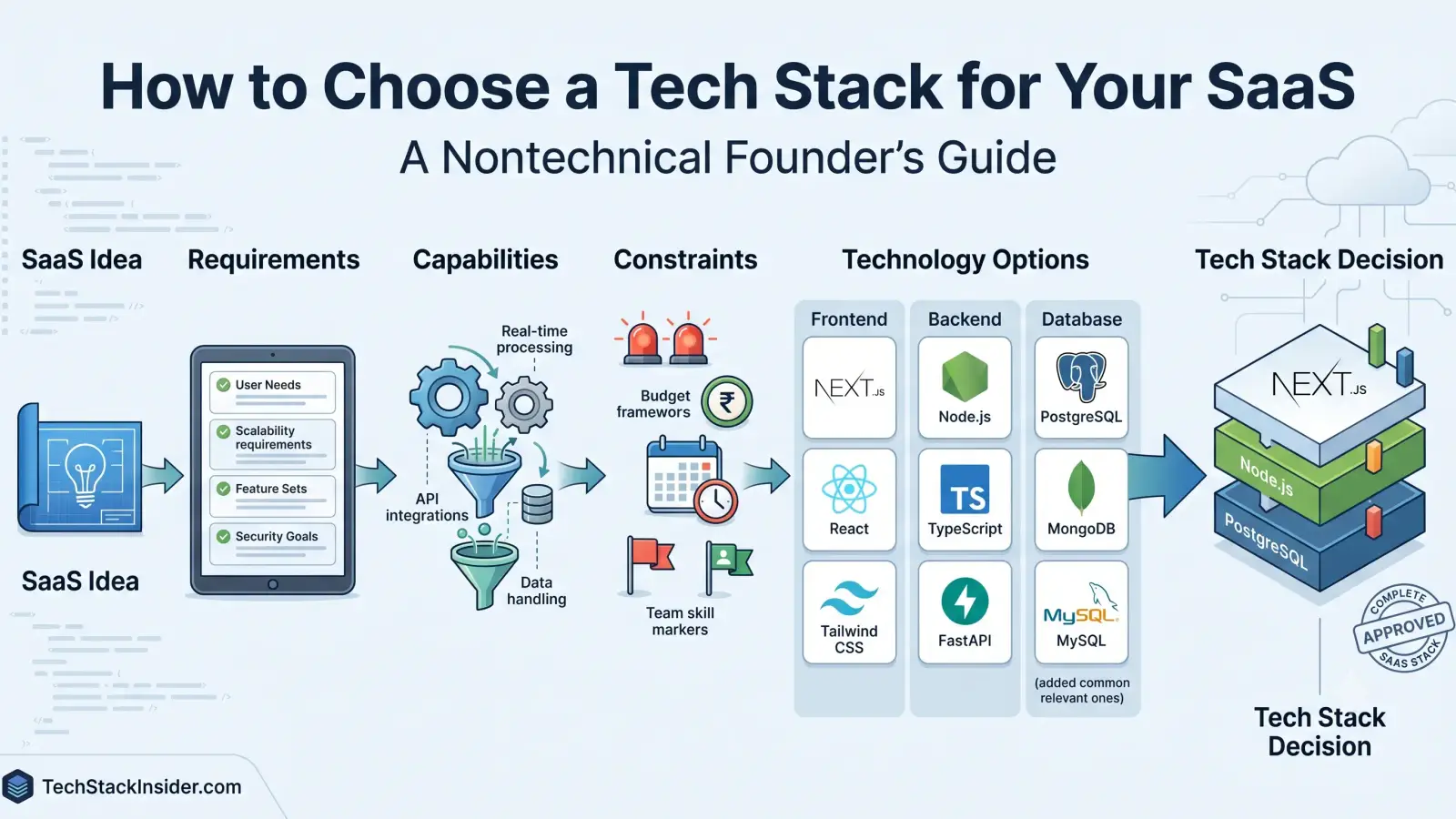
Choosing a technology stack is one of the first major decisions you will face when building a SaaS product.
It is also one of the easiest decisions to approach backwards.
A founder has an idea, searches for the “best” programming language, database, framework, cloud provider, or AI coding tool, and starts assembling technologies before understanding what the product actually needs.
That creates a problem.
A technology is not a product requirement.
Your SaaS needs capabilities. Technology is how you implement those capabilities.
The better sequence is:
SaaS idea ? requirements ? capabilities ? constraints ? technology options ? trade-offs ? decision
This guide explains how to follow that process, even if you are not a developer.
The Short Answer
You do not need to find the “best tech stack.”
You need to find a stack that is sufficient for your product, appropriate for your constraints, and changeable when your requirements evolve.
A practical decision model is:
Product
   ?
Requirements
   ?
Capabilities
   ?
Constraints
   ?
Technology Options
   ?
Trade-offs
   ?
Technology Decision
   ?
Implementation
For an early-stage SaaS, the right question is therefore not:
“Should I use React, Next.js, Node.js, Python, PostgreSQL, or MongoDB?”
Start with:
“What does my SaaS need to be able to do?”
Only then should technology enter the conversation.
1. Start With the SaaS, Not the Tech Stack
Suppose you want to build a SaaS for independent consultants.
A vague requirement might be:
“I need an application with AI, payments, dashboards, and a database.”
That is already too technology-oriented.
Start with the user.
Imagine the core workflow is:
Consultant
   ?
Creates client workspace
   ?
Adds client information
   ?
Creates project
   ?
Uploads documents
   ?
AI analyzes documents
   ?
Consultant reviews result
   ?
Generates report
   ?
Client receives report
   ?
Consultant gets paid
Now we can identify actual product requirements.
| Product requirement | Capability required |
|---|---|
| User accounts | Authentication |
| Client workspaces | Multi-tenant data model |
| Project management | Application/business logic |
| Document uploads | File storage |
| AI analysis | AI inference capability |
| Generated reports | Document generation |
| Client delivery | Notifications/access control |
| Payments | Payment processing |
| Usage tracking | Metering/analytics |
| Secure data | Security and authorization |
Only after identifying these capabilities should you start evaluating technologies.
2. Requirement ? Capability ? Technology
This is the most useful mental model for a nontechnical founder.
Consider authentication.
Your requirement is:
Users need to securely sign in.
The capability is:
Authentication and identity management.
Possible technology approaches include:
- Managed authentication service
- Application framework authentication
- Identity provider
- Custom authentication system
The technology is therefore downstream of the requirement.
The same pattern applies throughout your SaaS.
Requirement
     ?
Capability
     ?
Technology options
     ?
Trade-offs
     ?
Decision
This prevents a common mistake:
Choosing a technology simply because it is popular.
Popularity is evidence that a technology has adoption. It is not proof that it is appropriate for your product.
3. Understand the Major Parts of a SaaS
Most SaaS products can be decomposed into several technical capabilities.
You do not need to understand every implementation detail, but you should understand what each layer does.
Frontend
The frontend is what users interact with.
It handles things such as:
- pages
- forms
- dashboards
- navigation
- user interactions
- displaying application data
Common technologies include JavaScript/TypeScript frameworks and component libraries.
The important question is:
What user experience does the product require?
Not:
Which frontend framework is currently trending?
Backend
The backend contains application logic and exposes capabilities to the frontend.
For example:
User creates project
       ?
Backend validates request
       ?
Business rules execute
       ?
Database updated
       ?
Response returned
Backend technology may be based on JavaScript/TypeScript, Python, Java, Go, C#, or other ecosystems.
The language matters.
But the business logic, maintainability, security, and operational requirements matter more.
Database
Your SaaS will usually need persistent data.
Examples:
- users
- organizations
- subscriptions
- projects
- invoices
- documents
- settings
- activity records
For many SaaS applications, a relational database is a natural starting point because the data contains relationships.
For example:
Organization
     ¦
     +-- Users
     ¦
     +-- Projects
     ¦
     +-- Subscriptions
     ¦
     +-- Documents
A database decision should therefore begin with:
What data do we have, and how is it related?
Not:
Which database is the fastest?
4. SaaS Architecture Is More Than a List of Technologies
A technology stack is often represented like this:
Frontend
Backend
Database
Cloud
AI
That is useful, but incomplete.
A real SaaS system has relationships between components.
For example:
Browser
   ?
Frontend
   ?
Backend API
   ?
Database
   ?
External Services
An AI-enabled SaaS might look like:
User
 ?
Frontend
 ?
Application Backend
 +-- Database
 +-- File Storage
 +-- AI Model
 +-- Payment Provider
 +-- Email Service
Now the architectural questions become more important.
What happens if the AI provider is unavailable?
What happens if payment succeeds but your application does not record the subscription?
What happens when a user deletes a document?
Who can access another customer’s data?
Where is sensitive information stored?
These are system-design questions, not merely framework questions.
5. Separate Requirements From Constraints
Two SaaS products can need the same capabilities but choose different technologies because their constraints are different.
Consider two founders.
Founder A
- 100 expected users
- small budget
- one developer
- simple application
- limited operational requirements
Founder B
- enterprise customers
- strict security requirements
- large data volume
- multiple engineering teams
- compliance requirements
- global availability
Both may need:
Authentication
Database
API
File storage
Payments
Monitoring
But their technology decisions may be very different.
This is why:
There is no universally best SaaS tech stack.
There is only a technology choice that is more or less suitable for a particular set of requirements and constraints.
6. The Constraints You Should Identify First
Before choosing technologies, write down your constraints.
Product constraints
- What must the product do?
- What is the core workflow?
- What is optional?
- What can wait until later?
Business constraints
- Budget
- Time to MVP
- Revenue model
- Target customer
- Expected growth
- Enterprise requirements
Team constraints
- Who will build it?
- What skills do they have?
- Who will maintain it?
- Will you hire developers later?
Technical constraints
- Security
- Performance
- Availability
- Data volume
- Integration requirements
- AI requirements
- Compliance
Operational constraints
- Monitoring
- Backups
- Deployment
- Incident response
- Support
- Cost management
Write these down before comparing technologies.
7. Choose the Simplest Architecture That Meets the Requirements
One of the most common startup mistakes is building an architecture for a hypothetical future.
A founder imagines:
“What if we eventually have 10 million users?”
Then the MVP receives:
37 users.
Complexity has a cost.
Every additional infrastructure component creates another thing to understand, secure, monitor, upgrade, debug, and pay for.
For an early SaaS, a simple architecture might be:
Web Application
      ?
Application Server
      ?
PostgreSQL
      ?
Managed Storage
As requirements grow, the system can evolve:
Load Balancer
      ?
Application Instances
      ?
Database
 +-- Read Replicas
 +-- Cache
      ?
Queue
      ?
Background Workers
      ?
Object Storage
And eventually:
Users
 ?
CDN
 ?
Load Balancer
 ?
Application Layer
 +-- API
 +-- Workers
 +-- Services
      ?
Data Layer
 +-- Database
 +-- Cache
 +-- Object Storage
 +-- Search
The important principle is:
Architecture should evolve because requirements demand it, not because diagrams look impressive.
8. Monolith vs. Microservices
You may encounter advice telling you to build microservices from day one.
For an early SaaS, the more useful question is:
Do I have a problem that requires service-level separation?
A modular monolith can often provide a simpler starting point.
For example:
SaaS Application
¦
+-- Authentication
+-- Users
+-- Billing
+-- Projects
+-- Notifications
+-- AI
These modules can have clear boundaries without becoming separate deployable services.
Later, if one capability develops different scaling, deployment, security, or ownership requirements, it can potentially be separated.
This gives you:
Modularity without unnecessary operational complexity.
9. Managed Services Can Be a Strategic Choice
A nontechnical founder often asks:
“Should we build this ourselves?”
That is usually the wrong first question.
Ask:
Is this capability part of our competitive advantage?
If your SaaS’s differentiation is AI-powered financial analysis, building your own authentication system may not create strategic value.
You might use a managed authentication service.
Likewise, you may use managed services for:
- authentication
- payments
- object storage
- databases
- analytics
- monitoring
- AI inference
The objective is not to minimize the number of external services.
The objective is to minimize unnecessary complexity while preserving important control.
10. Evaluate Technology Using a Decision Matrix
Once you know what you need, create a short list of viable technologies.
Then evaluate them consistently.
| Criterion | Question |
|---|---|
| Capability fit | Does it solve the actual requirement? |
| Complexity | How difficult is it to operate? |
| Cost | What will it cost at current scale? |
| Scalability | Can it grow with the product? |
| Ecosystem | Are libraries and integrations available? |
| Talent | Can qualified developers work with it? |
| Security | Can it satisfy your security requirements? |
| Reliability | What happens when something fails? |
| Portability | How difficult is it to change later? |
| Vendor dependency | How much control are you giving the provider? |
Don’t assign scores simply because a spreadsheet expects them.
Instead, document the reasoning.
For example:
Requirement:
Reliable transactional data

Option:
Relational database

Why:
Strong consistency and mature transaction support.

Constraint:
Small engineering team

Implication:
Prefer a managed database rather than operating database infrastructure manually.
That is a technology decision.
11. Think in Trade-offs
Every technology decision has trade-offs.
A solution might be:
- easier to build
- but harder to customize
Another might be:
- more flexible
- but more expensive to operate
Another might be:
- inexpensive initially
- but create migration work later
There is rarely a free advantage.
A good decision document therefore looks like:
Decision
Use X for capability Y.

Why
It satisfies the current requirement with acceptable complexity.

Trade-off
We give up Z.

Future trigger
Reconsider if requirement A becomes true.
This last part is extremely valuable.
You don’t need to predict the future.
You need to know what future condition would cause you to revisit today’s decision.
12. Don’t Confuse Scalability With Complexity
Scalability means the system can handle increasing demand.
It does not mean:
“Use every scalable technology immediately.”
Suppose your SaaS has 500 users.
A simple architecture that comfortably handles your workload may be completely appropriate.
The question is:
What workload are we designing for?
Define measurable conditions:
Users
Requests per second
Database size
File volume
AI requests
Background jobs
Geographic distribution
Availability requirement
Then architecture becomes an engineering response to measurable conditions.
13. Estimate Cost Before Choosing
Technology decisions have both direct and indirect costs.
Direct costs
- hosting
- database
- storage
- API usage
- AI inference
- payment processing
- monitoring
Indirect costs
- developer time
- maintenance
- debugging
- upgrades
- vendor migration
- operational complexity
A cheap service that consumes significant engineering time may not actually be cheap.
A useful model is:
Total Cost
=
Infrastructure Cost
+
Third-Party Service Cost
+
Engineering Cost
+
Maintenance Cost
+
Migration Risk
You don’t need perfect numbers.
You need enough information to compare the major trade-offs.
14. AI Changes How SaaS Products Are Built
AI coding tools have reduced the amount of code a founder or small team may need to write manually.
But they do not remove system-design decisions.
An AI coding assistant can help generate:
- components
- API endpoints
- database queries
- tests
- configuration
- documentation
But someone still needs to decide:
What should exist?
        ?
What data should be stored?
        ?
Who is allowed to access it?
        ?
What happens when something fails?
        ?
What external systems are trusted?
        ?
What should happen at scale?
This means the value of requirements and architecture thinking increases, even when implementation becomes easier.
The bottleneck can move from:
“How do I write this code?”
to:
“What system should I build?”
15. Be Careful With AI Architecture
If AI is part of your SaaS, treat it as a capability rather than the entire architecture.
For example:
Application
    ?
AI capability
 +-- Model
 +-- Prompt/context
 +-- Retrieval
 +-- Tool access
 +-- Validation
 +-- Monitoring
Ask:
- What information does the model receive?
- What information must never be exposed?
- What happens when the model is wrong?
- Is the output deterministic enough?
- Does a human need to review it?
- What does each request cost?
- What happens if the model provider changes?
The AI model is only one component of an AI-enabled system.
16. Security Is Part of Architecture
Security should not be added after the stack is chosen.
At minimum, consider:
Identity
Who is the user?
Authentication
How do they prove their identity?
Authorization
What are they allowed to do?
Data isolation
Can one customer access another customer’s data?
Secrets
Where are API keys and credentials stored?
Encryption
What data requires protection in transit and at rest?
Logging
What events need to be recorded?
Backups
How would you recover from data loss?
For a SaaS, one of the most important questions is:
Can tenant A ever access tenant B’s data?
This should influence the data model and application architecture from the beginning.
17. Your Tech Stack Is a Set of Relationships
Don’t think of your stack as a shopping list.
Think of it as a system.
For example:
Frontend
   ¦
   ¦ HTTPS
   ?
Backend
   ¦
   +---- Database
   ¦
   +---- Authentication
   ¦
   +---- Payment Provider
   ¦
   +---- Email Provider
   ¦
   +---- Object Storage
   ¦
   +---- AI Provider
Every relationship introduces assumptions.
Ask:
- Who owns the data?
- What happens when the dependency fails?
- How is authentication propagated?
- How are retries handled?
- How are duplicate requests handled?
- What happens if an external API changes?
- Can the dependency be replaced?
This is where system design begins to matter more than the individual technologies.
18. A Practical Technology Selection Process
Use this process before committing to your stack.
Step 1 — Define the product
Write down:
Who is the user?
What problem are we solving?
What is the core workflow?
What must the MVP do?
Step 2 — Identify capabilities
Convert requirements into capabilities.
Requirement
      ?
Capability
Step 3 — Identify constraints
Document:
- budget
- timeline
- team
- security
- expected workload
- integrations
- compliance
Step 4 — Generate technology options
For each capability, identify two or three credible options.
Do not research twenty technologies unnecessarily.
Step 5 — Compare trade-offs
Evaluate:
Fit
Complexity
Cost
Security
Scalability
Maintainability
Portability
Step 6 — Select the simplest sufficient option
Not the most fashionable.
Not the most sophisticated.
The simplest option that satisfies the requirements and constraints.
Step 7 — Document the decision
Record:
What did we choose?
Why?
What did we reject?
What trade-off did we accept?
When should we reconsider?
Step 8 — Build the smallest useful system
Don’t build infrastructure for hypothetical requirements.
Step 9 — Measure
Watch:
- cost
- performance
- errors
- usage
- reliability
- developer effort
Step 10 — Revisit when conditions change
Architecture is not a one-time decision.
It evolves with the product.
19. Example: Turning a SaaS Idea Into a Technology Decision
Imagine your SaaS lets small businesses upload invoices and automatically extract financial information.
Start with the requirement:
Users need to upload invoices.
Capability:
File upload and storage.
Possible architecture:
User
 ?
Web Application
 ?
Backend
 ?
Object Storage
Next requirement:
The system needs to extract information from invoices.
Capability:
Document processing and AI/OCR.
Architecture:
Invoice
 ?
Object Storage
 ?
Processing Worker
 ?
OCR / AI
 ?
Validation
 ?
Database
Next requirement:
The customer needs to review the extracted information.
Capability:
Structured application data + user interface.
Now the system becomes:
                    +-- Object Storage
                    ¦
User ? Web App ? Backend ? Database
                    ¦
                    +? Processing ? AI/OCR
Notice what happened.
We didn’t start by asking:
“Which framework should I use?”
We first discovered what the system needed.
The technology decision became much easier after that.
20. A Nontechnical Founder’s Tech-Stack Checklist
Before approving a technology choice, ask your developer or technical advisor:
Product
- What requirement does this technology satisfy?
- Is that requirement necessary for the MVP?
Architecture
- What component will this become?
- What does it depend on?
- What depends on it?
Cost
- What does it cost now?
- What costs increase as usage grows?
Complexity
- Who will maintain it?
- What happens when it breaks?
Security
- What data does it access?
- How is access controlled?
Scalability
- What measurable condition would require us to change the architecture?
Portability
- If we replace it later, how difficult will migration be?
Decision
- What alternatives did we consider?
- Why didn’t we choose them?
- What trade-off are we accepting?
If you can get clear answers to these questions, you can participate meaningfully in the technology decision without becoming a software engineer.
21. The Stack Should Follow the Business
A SaaS technology stack is ultimately an implementation of a business system.
Your product determines the requirements.
Requirements determine capabilities.
Capabilities constrain the technology choices.
Technology choices create trade-offs.
And those trade-offs affect:
- cost
- speed
- reliability
- security
- maintainability
- future change
So the chain is:
BUSINESS PROBLEM
       ?
PRODUCT
       ?
REQUIREMENTS
       ?
CAPABILITIES
       ?
CONSTRAINTS
       ?
TECHNOLOGY OPTIONS
       ?
TRADE-OFFS
       ?
ARCHITECTURE
       ?
IMPLEMENTATION
       ?
MEASUREMENT
       ?
EVOLUTION
That is a much more durable way to think about a tech stack than memorizing today’s popular technologies.
Final Takeaway
You don’t need to become a developer to make better technology decisions.
You need to learn how to ask the right questions.
Don’t begin with:
“What is the best tech stack for a SaaS?”
Begin with:
“What does my SaaS need to do?”
Then:
“What capabilities are required?”
Then:
“What constraints do I have?”
Then:
“Which technologies satisfy those capabilities with an acceptable level of cost and complexity?”
And finally:
“What would have to change before we reconsider this decision?”
That approach gives you something more valuable than a list of fashionable technologies.
It gives you a repeatable technology decision process.
For a nontechnical founder, that is the real foundation of a good SaaS tech stack.
Related Articles
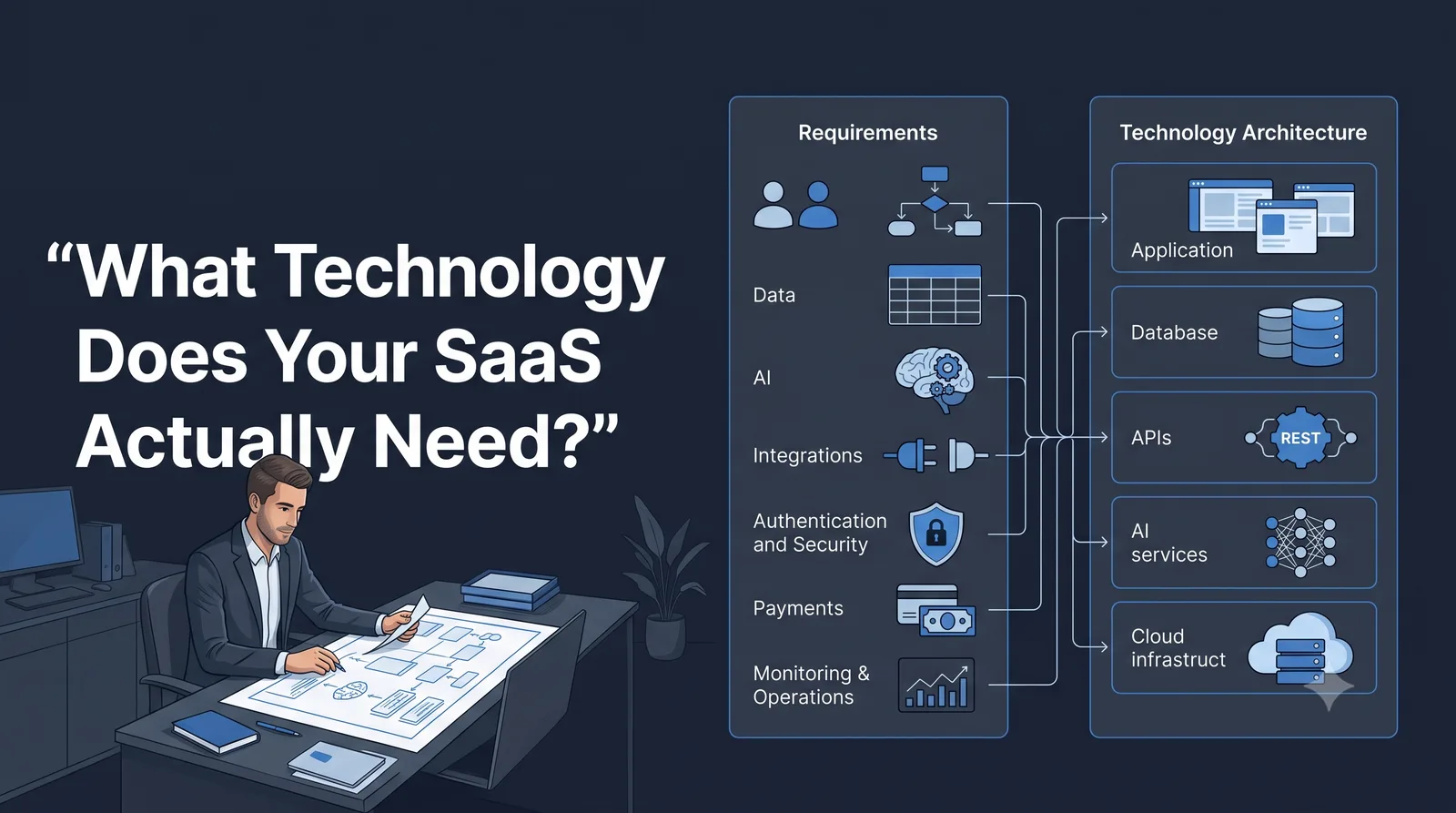
What Technology Does Your SaaS Actually Need? A Nontechnical Founder’s Guide
SaaS requirements explained for nontechnical founders. Learn what technology your SaaS actually needs, from data and AI to integrations, security, and MVP requirements.
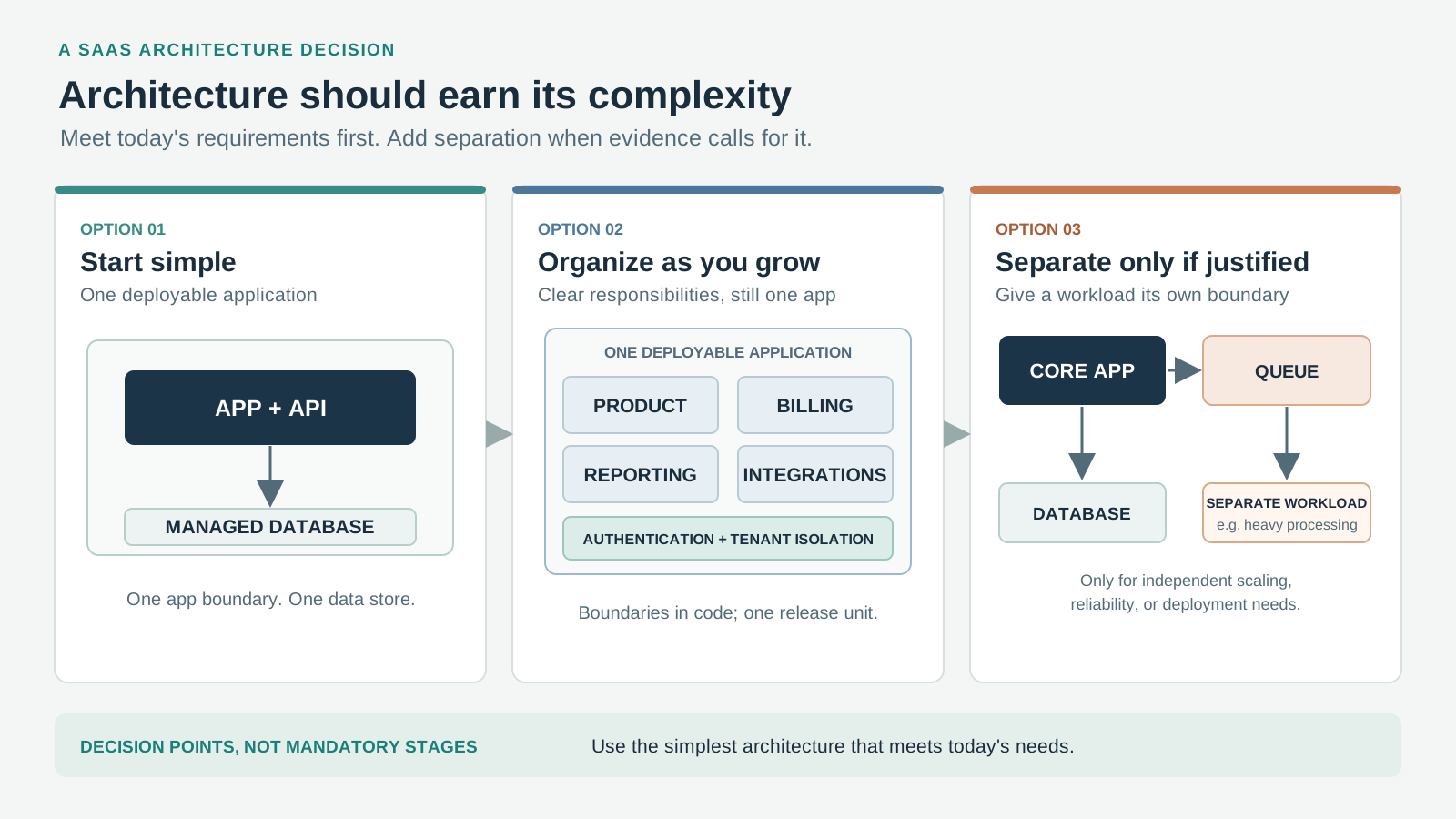
How Much Architecture Does Your SaaS Actually Need?
A practical guide to deciding how much SaaS architecture a founder actually needs, when a monolith is enough, and when complexity is justified by real product and operational requirements.
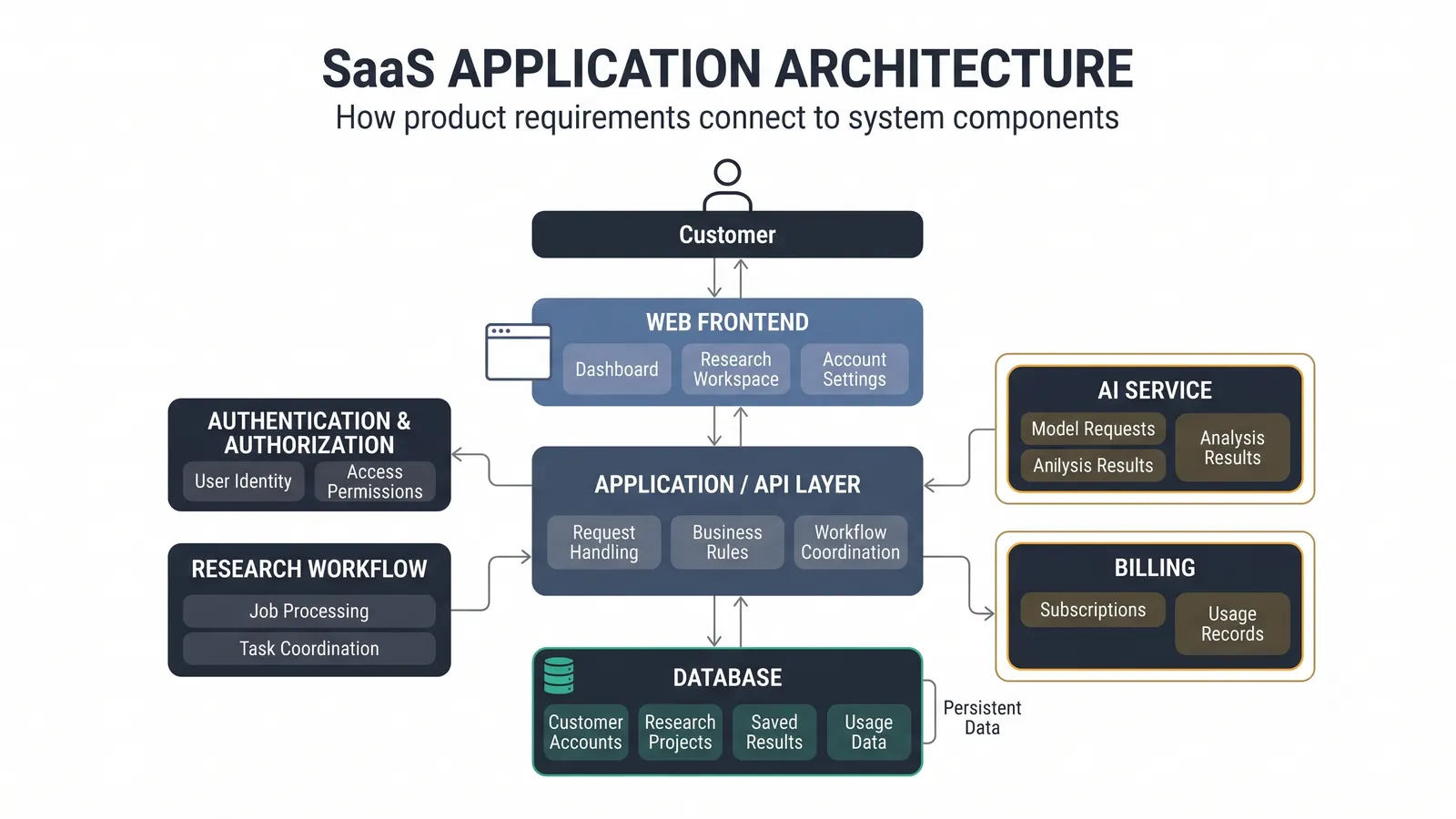
How to Design a SaaS Architecture: A Nontechnical Founder’s Guide
A practical guide to designing a SaaS architecture by connecting product requirements, system capabilities, technology components, relationships, and architecture decisions.

Can You Build a SaaS Without Being a Developer? What You Really Need to Know in 2026
A practical guide for nontechnical founders evaluating AI, no-code, low-code, and developer-assisted approaches to building and operating a SaaS.