How to Design a SaaS Architecture: A Nontechnical Founder’s Guide
A practical guide to designing a SaaS architecture by connecting product requirements, system capabilities, technology components, relationships, and architecture decisions.
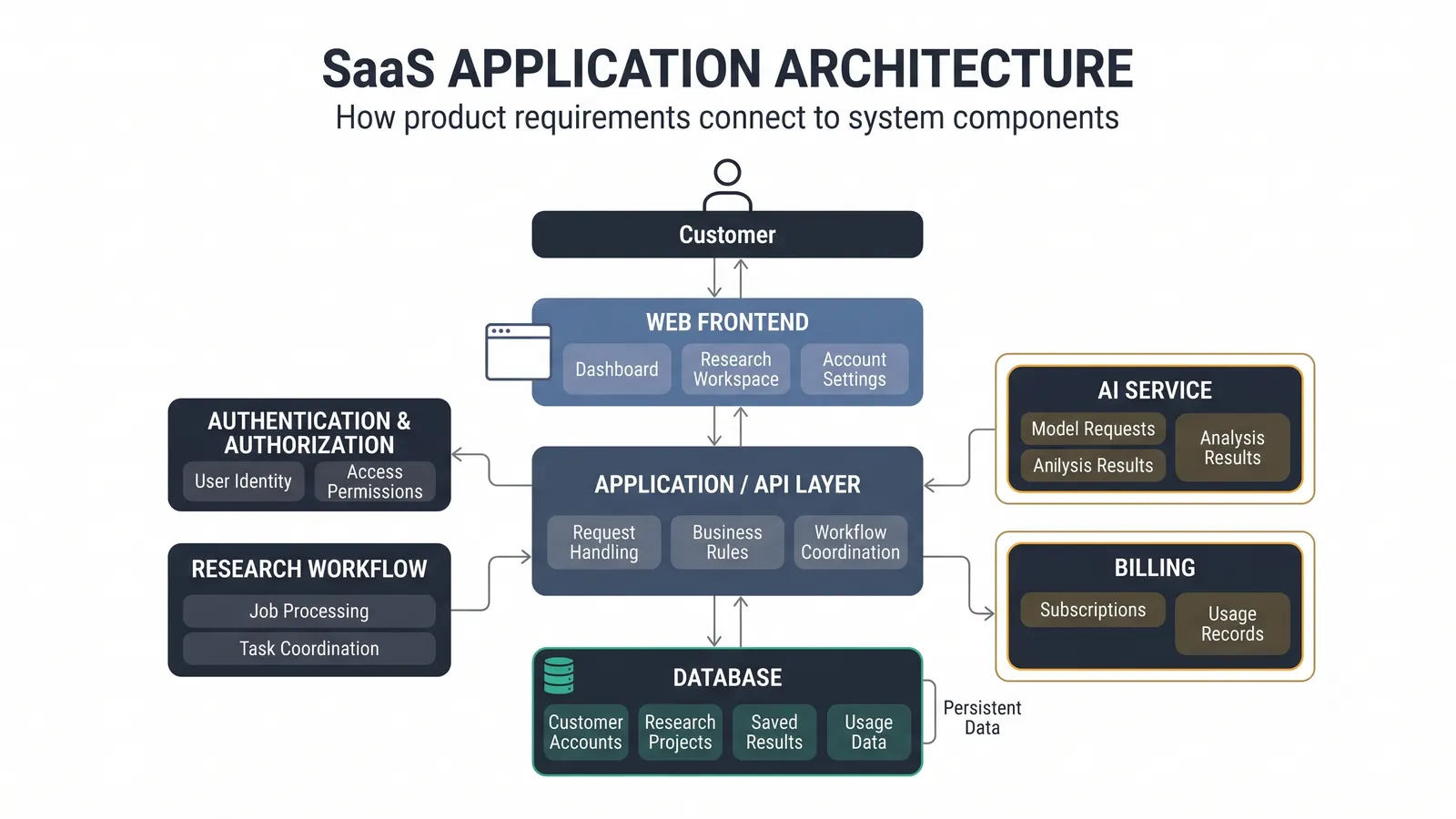
A SaaS product can look simple from the outside. A customer opens a web application, creates an account, enters a request, and receives a result. But behind that interaction, several different parts of a software system have to work together: the user interface, application logic, database, authentication, external services, infrastructure, and sometimes AI models or other specialized systems. The challenge is not simply choosing those technologies.The harder question is how they should work together. That is what software architecture is really about.
For a nontechnical founder, architecture does not mean designing every class, database table, or deployment script. It means understanding the structure of the product well enough to make sound decisions about what needs to exist, what each part is responsible for, how the parts communicate, and where complexity is actually justified.
A useful starting point is:
Requirements → Capabilities → Components → Relationships → Architecture → Technology decisions
The architecture comes from the product. It should not be the other way around.
Start with what the SaaS must do
Consider an AI-powered research SaaS.
The product might allow a customer to:
- create an account,
- start a research project,
- submit a question,
- gather information from external sources,
- use AI to analyze or summarize that information,
- save the research,
- return to it later, and
- pay for the service.
At first, these look like product features.
Architecturally, they are capabilities.
The distinction matters because a feature describes what the customer experiences, while a capability describes what the system must be able to do to provide that experience.
| Product requirement | Required capability | Architectural concern |
|---|---|---|
| Customer accounts | Identity management | Authentication |
| Different customer permissions | Access control | Authorization |
| Research projects | Persistent data | Database |
| Information gathering | External communication | APIs / services |
| AI analysis | AI processing | Model or AI service |
| Saved research | Data persistence | Storage |
| Subscriptions | Payment processing | Payment service |
| Web application | User interaction | Frontend |
This gives the architecture something concrete to respond to.
Instead of asking, “What technologies should this SaaS use?”, the more useful question becomes:
“What capabilities does this product require, and what is the simplest reliable way to provide them?”
What architecture actually describes
A technology stack tells us which technologies are being used.
Architecture describes how the important parts of the system are organized and how they interact.
A simplified SaaS might contain:
- a frontend for the user interface,
- a backend for application logic,
- a database for persistent information,
- an authentication system for identity,
- external APIs and services for capabilities the application does not provide itself,
- an AI service for model-based processing,
- a payment system for subscriptions, and
- infrastructure that runs and exposes the application.
These components are not equally important in every SaaS. Some products may not need AI. Some may not have subscriptions. Some may use managed services instead of building certain capabilities internally.
The architectural question is therefore not whether every box belongs in the diagram.
It is whether each necessary capability has a clear owner and a clear relationship with the rest of the system.
Architecture becomes clearer when a real request is followed
Take one interaction from the AI research product.
A customer submits:
“Analyze the main competitors in this market and summarize how they position their products.”
The request starts in the frontend.
The frontend is the part of the application the customer interacts with: the browser interface, forms, dashboards, buttons, and research workspace.
The request then reaches the backend.
The backend is where the application can enforce rules and coordinate work. It may determine whether the customer is authenticated, whether the account has permission to perform the operation, what research workflow should run, which external services should be called, and what information should be stored.
The backend may then communicate with external sources and an AI service.
The database can store the research project, account information, usage records, or the resulting analysis.
Finally, the backend returns the result to the frontend, where it becomes visible to the customer.
A simplified flow looks like this:
Customer
   │
   ▼
Frontend
   │
   ▼
Backend / Application Logic
   │
   ├──── Authentication & Authorization
   │
   ├──── Research Workflow
   │
   ├──── AI Service
   │
   ├──── External Sources / APIs
   │
   └──── Database
             │
             ▼
          Stored Data

Backend
   │
   ▼
Frontend
   │
   ▼
Customer
This is more useful than a technology list because it exposes the relationships.
The frontend does not need to know how the database works.
The database does not need to understand the user interface.
The AI provider does not need to own the entire application.
The backend coordinates the product’s rules and the relationships between these components.
That structure is architecture.
The frontend, backend, and database have different jobs
These terms appear in almost every SaaS discussion, but their architectural roles are more important than their definitions.
Frontend: where the product is experienced
The frontend is the customer-facing part of the application.
For a research SaaS, it might provide:
- the login screen,
- research workspace,
- project history,
- progress indicators,
- results,
- account settings, and
- billing information.
The frontend is concerned primarily with interaction and presentation.
It should not become the place where the entire business logic of the product lives.
Backend: where the application coordinates work
The backend sits behind the interface.
It can authenticate requests, enforce permissions, apply business rules, coordinate workflows, communicate with other services, and decide what data should be read or changed.
For the research SaaS, the backend might determine:
This request belongs to customer A, the user has permission to access the project, the account has sufficient usage allowance, and the research workflow can now begin.
That is application logic.
Database: where important information persists
A database provides durable storage for information the application needs to keep.
For the research product, that might include:
- customer accounts,
- users,
- research projects,
- saved sources,
- research results,
- subscription information, and
- usage records.
The database is not simply a storage box. Its structure influences how information is related, accessed, protected, and maintained.
These three components work together, but they have different responsibilities.
That separation is one of the foundations of a maintainable architecture.
APIs create the boundaries between systems
A SaaS rarely operates entirely by itself.
It may communicate with an AI provider, payment platform, email service, analytics system, cloud storage service, or external data source.
An API provides a structured way for one software system to communicate with another.
For example:
Your application
      │
      │ API request
      ▼
AI provider
      │
      │ API response
      ▼
Your application
The important architectural point is that the application is not necessarily implementing the AI capability itself.
It is depending on another system to provide that capability.
That dependency has consequences.
The external provider may have pricing limits, rate limits, availability requirements, API changes, or data-handling policies. If the SaaS depends heavily on that service, the dependency becomes part of the architecture and therefore part of the business decision.
This is why “use an API” is not the end of the architectural discussion.
The important questions include:
- What happens if the service is unavailable?
- How expensive is the dependency at higher usage?
- Can the provider be replaced?
- What information is sent to it?
- What happens to customer data?
- Is the application tightly coupled to its API?
Architecture makes those dependencies visible.
Authentication is different from authorization
This distinction becomes particularly important in SaaS products.
Authentication answers:
Who is this user?
Authorization answers:
What is this user allowed to access or do?
Suppose a company has five employees using the same SaaS account.
Authentication establishes the identity of each employee.
Authorization determines whether a particular employee can view a research project, invite another user, change billing information, or access administrative functions.
For a SaaS, this also connects identity to customer data.
A request for:
“Research project 123”
is not sufficient by itself.
The application also needs to establish whether the authenticated user is actually permitted to access project 123 and whether that project belongs to the appropriate customer account.
This is one reason security and data boundaries need to be considered during architecture rather than added after the application has already been built.
SaaS architecture has a multi-tenant problem
A SaaS normally serves multiple customers from the same product.
That creates a concept known as multi-tenancy.
A tenant is generally a customer account or organizational boundary within the application.
For example:
SaaS Application
│
├── Company A
│    ├── Users
│    ├── Projects
│    └── Data
│
├── Company B
│    ├── Users
│    ├── Projects
│    └── Data
│
└── Company C
     ├── Users
     ├── Projects
     └── Data
The exact implementation can vary. Customer data might be logically separated within shared infrastructure, placed into separate databases, or handled through other isolation strategies.
The architectural requirement remains the same:
One customer must not gain unauthorized access to another customer’s data.
That requirement affects the data model, authorization logic, database queries, testing, monitoring, and sometimes infrastructure design.
This is a good example of why architecture cannot be reduced to selecting a framework.
A business requirement creates a technical relationship and a set of constraints.
Build it, buy it, or use a service?
Not every capability deserves to be built internally.
An early SaaS might use:
- a managed authentication provider,
- a payment platform,
- an AI model provider,
- cloud object storage,
- an email delivery service, and
- managed database infrastructure.
This can reduce development effort and allow a small team to concentrate on the parts that actually differentiate the product.
But external services also create dependencies.
The decision should therefore consider more than development speed.
| Question | Why it matters |
|---|---|
| Does this capability differentiate the product? | Differentiated capabilities may justify internal ownership |
| Is a reliable service already available? | Rebuilding commodity functionality may add unnecessary work |
| What happens if the provider fails? | Availability becomes a dependency |
| How does pricing change with usage? | A cheap service can become expensive at scale |
| Can the provider be replaced? | Strong coupling can make future changes difficult |
| What customer data is involved? | Privacy and security requirements may affect the choice |
A useful principle is:
Own what creates meaningful differentiation or control; use reliable services for capabilities that do not need to be reinvented.
The actual decision depends on the product, its constraints, and its business model.
Monolith or microservices is a stage-dependent decision
Architecture discussions often reach microservices too early.
A monolith generally keeps the application’s major capabilities within one deployable application.
A microservices architecture separates capabilities into multiple independently deployable services.
Neither approach is automatically correct.
The important issue is what problem the separation solves.
An early SaaS with one development team may benefit from keeping the application relatively unified. The system can still have clear internal modules for users, research, billing, and other capabilities without turning every module into a separate service.
As the product grows, the conditions can change.
A particular workload may need to scale independently. Different teams may need independent deployment. A component may require stronger isolation or have very different reliability requirements.
Those are architectural reasons to consider greater separation.
The wrong question is:
“Which architecture is more advanced?”
The better question is:
“What requirement justifies the additional complexity?”
A more distributed architecture introduces more than additional boxes on a diagram. It can also introduce network communication, service discovery, deployment coordination, observability, failure handling, and operational overhead.
Complexity is useful when it solves a real problem.
Otherwise, it becomes another problem the product has to operate.
Design for the product that exists, not an imaginary future
Architecture should allow for reasonable growth, but it should not be built around assumptions that have no evidence behind them.
An early SaaS may have:
- a small number of customers,
- a small engineering team,
- uncertain product-market fit,
- limited infrastructure requirements, and
- a changing understanding of the product itself.
That environment calls for a different architecture from a mature platform serving millions of users across multiple regions.
A sensible first architecture can still establish good boundaries.
For example:
- customer data should have clear ownership,
- authentication should be reliable,
- business rules should have a clear home,
- external dependencies should be identifiable,
- important operations should be observable,
- deployment should be repeatable, and
- the application should be structured so that likely changes do not require rebuilding everything.
The objective is not to predict exactly what the product will become.
The objective is to make the current product simple enough to build and structured enough to evolve.
Architecture should also account for failure
A system is not defined only by what happens when everything works.
External services fail. Databases become unavailable. Network requests time out. AI providers return errors. Users submit unexpected input. Infrastructure reaches capacity.
The architecture should therefore answer questions such as:
- What happens when an external API does not respond?
- Can a failed operation be retried safely?
- What happens if a payment succeeds but the application does not immediately receive confirmation?
- Can users see whether a long-running research job is still processing?
- Where are errors recorded?
- How does the team know that something has gone wrong?
These concerns lead to concepts such as retries, timeouts, queues, logging, monitoring, alerts, and observability.
A nontechnical founder does not need to implement these mechanisms personally.
But they are part of the architecture because they affect whether the product remains reliable when real users begin depending on it.
Architecture is also a cost decision
Every architectural choice has an operating cost.
A system may require:
- application servers,
- database capacity,
- storage,
- network traffic,
- third-party APIs,
- AI model usage,
- monitoring,
- backups,
- support, and
- engineering time.
The cheapest architecture is not necessarily the right one.
A low-cost design that creates frequent failures can become expensive through lost customers and engineering effort.
Likewise, an elaborate architecture can waste money before the product has enough usage to justify it.
The useful question is therefore not:
“What is the cheapest architecture?”
It is:
“What level of reliability, performance, security, and flexibility does the product actually need at its current stage?”
That brings technical architecture back to the business.
A practical architecture decision framework
Before development begins, the architecture can be worked through in this order.
1. Establish the requirements
What must the product do?
Separate essential requirements from assumptions about future growth.
2. Translate requirements into capabilities
For example:
Customer accounts → identity
Research requests → processing workflow
Saved projects → persistent storage
Subscriptions → payment processing
3. Identify the components
Determine which parts of the system provide those capabilities.
Some will be built internally. Others may come from external services.
4. Map the relationships
Determine how requests, data, and events move between components.
This is where the architecture starts to become visible.
5. Identify the conditions
Consider:
- expected users,
- data volume,
- security requirements,
- customer isolation,
- performance,
- availability,
- compliance,
- budget,
- team capability, and
- external dependencies.
These conditions influence architectural choices.
6. Evaluate the trade-offs
Every meaningful architectural decision has consequences.
More separation can improve independent scaling but increase operational complexity.
A managed service can reduce development effort but create vendor dependency.
A simple architecture can accelerate an MVP but may require evolution later.
The objective is not to eliminate trade-offs.
It is to make them explicit.
7. Select the technology
Technology selection comes after the architecture has established what the system needs.
A framework, database, cloud service, or AI provider should have a reason for being there.
The technology is the implementation of the decision—not the starting point of the decision.
A simple architecture for an early AI SaaS
Putting the ideas together, an early AI research SaaS might look roughly like this:
                         CUSTOMER
                            │
                            ▼
                       WEB FRONTEND
                            │
                            ▼
                  APPLICATION / API LAYER
                            │
          ┌─────────────────┼─────────────────┐
          │                 │                 │
          ▼                 ▼                 ▼
   AUTHENTICATION      BUSINESS LOGIC      BILLING
          │                 │
          │          ┌──────┴──────┐
          │          ▼             ▼
          │      AI SERVICE   EXTERNAL DATA
          │
          └──────────────────────────────┐
                                         ▼
                                      DATABASE
                                         │
                                         ▼
                                   CUSTOMER DATA
This is not a prescribed stack.
The frontend could use one technology or another. The backend could use different languages and frameworks. The database could be relational or use another appropriate model. The AI capability could come from an external provider or, under different conditions, be hosted and operated independently.
The architecture remains understandable because the responsibilities and relationships are clear.
That is the part that should survive technology changes.
What should be clear before development starts?
A founder does not need a perfect architecture document before the first feature is built.
But the major decisions should not remain accidental.
At minimum, there should be a shared understanding of:
| Area | Question |
|---|---|
| Product capabilities | What must the system actually do? |
| Application boundaries | Where does each major responsibility live? |
| Data | What information must persist, and who owns it? |
| Identity | How are users authenticated and authorized? |
| Customer isolation | How is tenant data separated? |
| External services | Which capabilities depend on outside providers? |
| Architecture style | What level of separation is justified? |
| Reliability | What happens when important components fail? |
| Scalability | Which parts may need to grow independently? |
| Cost | What infrastructure and service costs are acceptable? |
| Operations | How will failures, usage, and system behavior be observed? |
The purpose is not to produce a diagram that never changes.
The purpose is to make the important assumptions visible before they become expensive problems.
The architecture decision
A good SaaS architecture is not the one with the most components.
It is not necessarily the one used by the largest technology companies.
It is not the architecture that looks most impressive in a diagram.
It is the architecture whose structure makes sense for the product’s requirements, constraints, team, customers, and current stage.
That means the decision should ultimately answer six questions:
What does the product need to do?
Which capabilities are required?
Which components provide those capabilities?
How do those components communicate?
What conditions could change the design?
What level of complexity is justified by the evidence?
Those questions turn architecture from a collection of technical terms into a business and technology decision that can actually be evaluated.
From requirements to a buildable system
The architecture stage sits between the product idea and implementation.
The progression is:
Idea → Opportunity → Requirements → Capabilities → Technology → Architecture → Build → Validate → Deploy → Operate → Scale
The important transition is from what the product needs to do to how the software will make that possible.
That is the real purpose of architecture.
A founder does not need to become an engineer to participate meaningfully in that decision. But a development team also should not be expected to make major architectural choices without understanding the product requirements, business constraints, customer model, and expected operating conditions.
The strongest architecture decisions happen when those perspectives meet.
Requirement → Capability → Component → Relationship → Condition → Evidence → Decision → Action
Once that structure is clear, the next problem is no longer “What should the architecture be?”
It becomes much more practical:
How should this architecture be turned into a working SaaS MVP?
Related Articles

Can You Build a SaaS Without Being a Developer? What You Really Need to Know in 2026
A practical guide for nontechnical founders evaluating AI, no-code, low-code, and developer-assisted approaches to building and operating a SaaS.

Before You Build: How AI-Powered Research Can Uncover a Promising SaaS Opportunity
Learn how AI-powered research can help you investigate a SaaS idea, understand customers and workflows, study existing solutions, challenge assumptions, and decide what to validate before building.
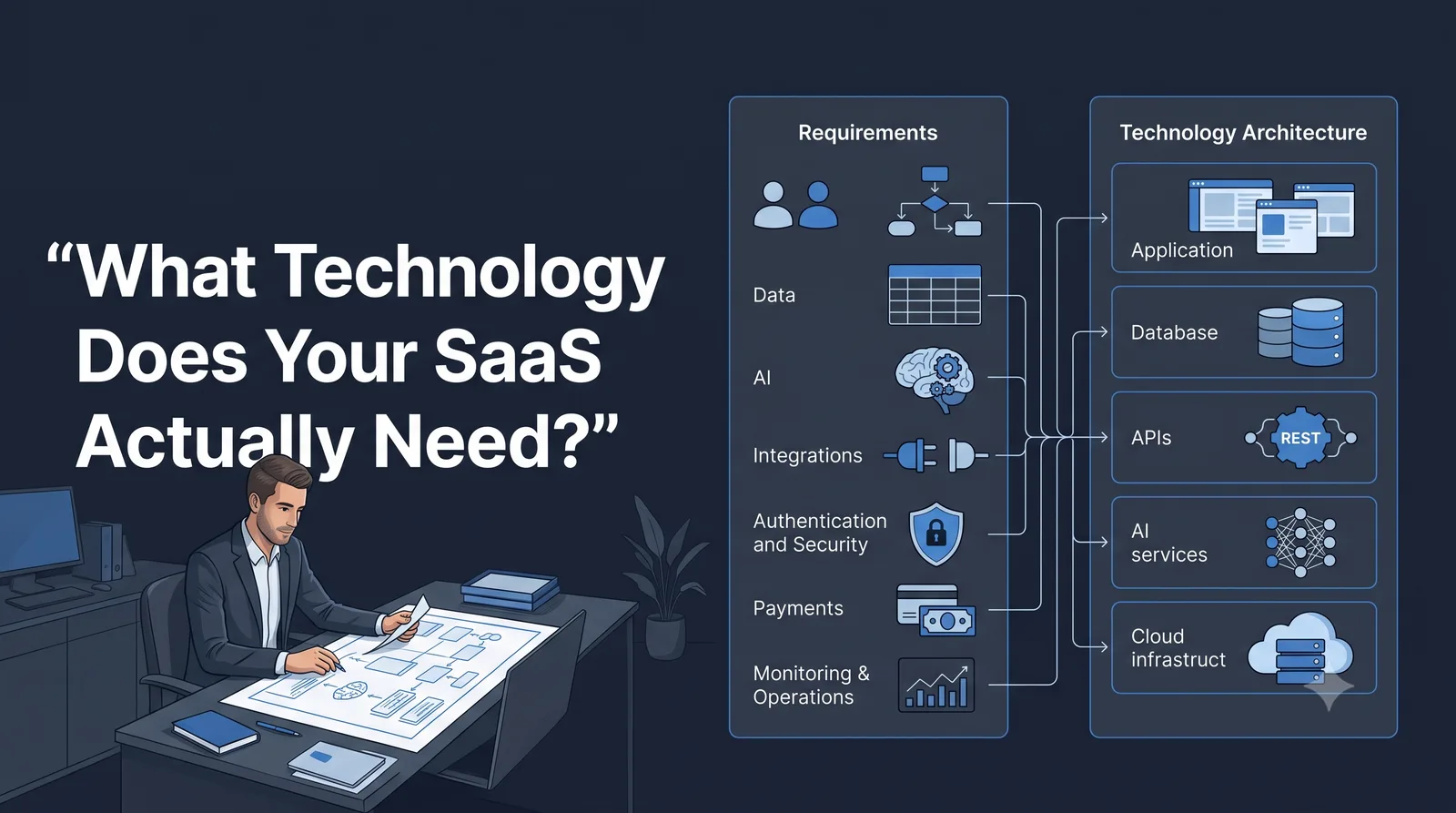
What Technology Does Your SaaS Actually Need? A Nontechnical Founder’s Guide
SaaS requirements explained for nontechnical founders. Learn what technology your SaaS actually needs, from data and AI to integrations, security, and MVP requirements.
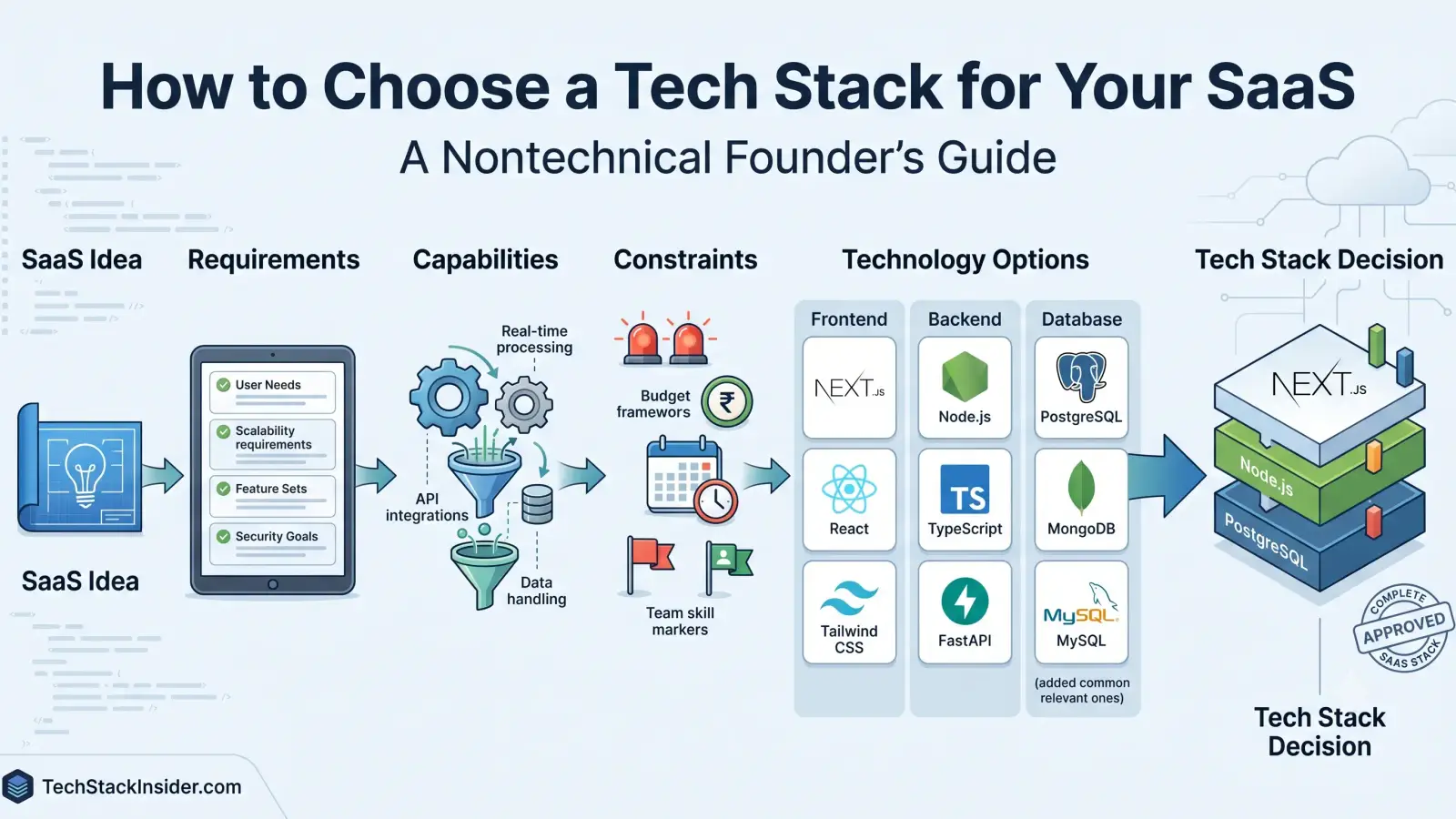
How to Choose a Tech Stack for Your SaaS
A practical guide for nontechnical SaaS founders to choose a tech stack by defining product requirements, comparing capabilities, and weighing cost, complexity, security, and team constraints.